


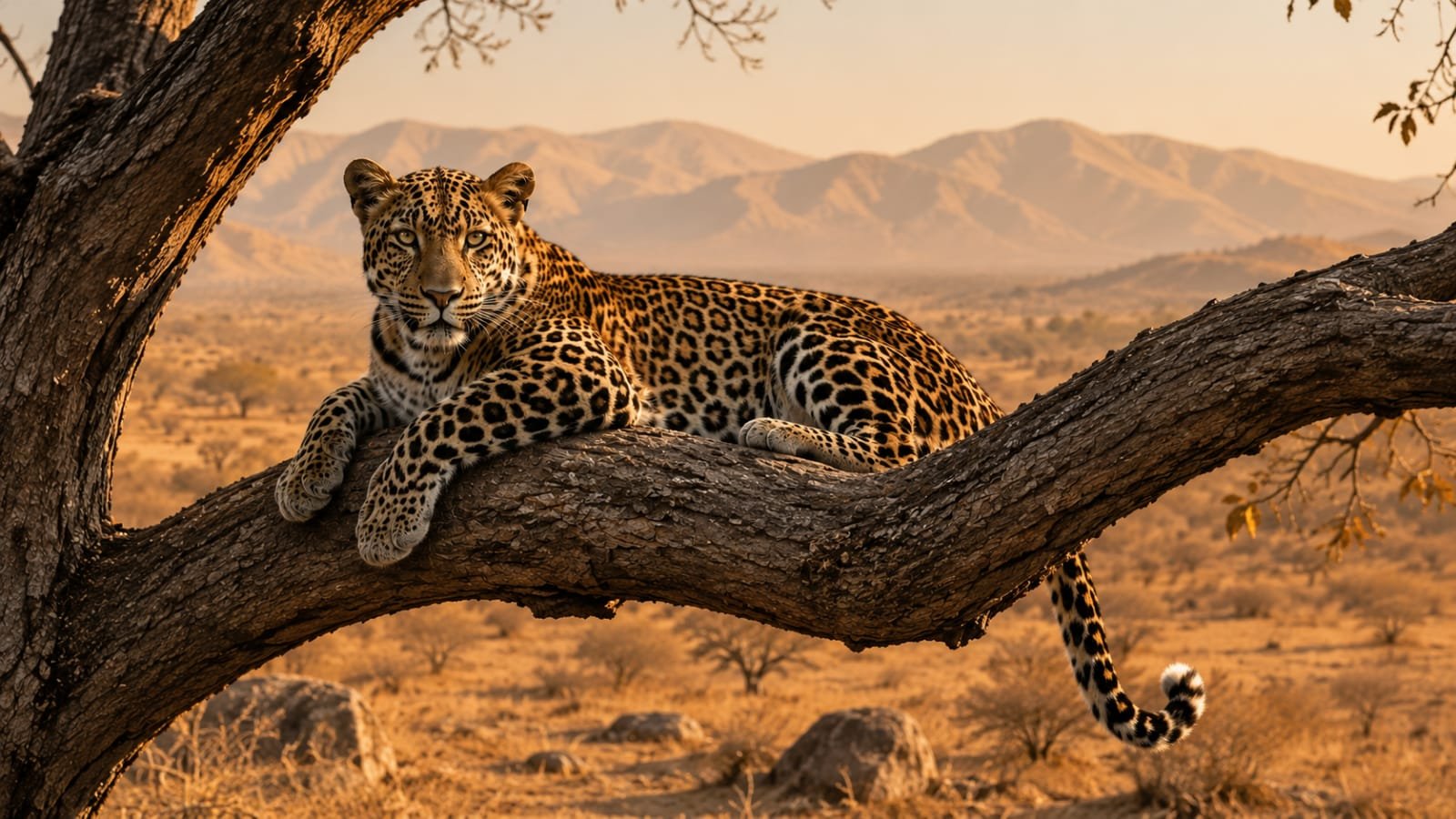
A Tense Morning in Bahapur Baliya, Uttar Pradesh, India
August 25, 2026.
Bahapur Baliya village was unusually quiet that morning. A sense of fear had been hanging over the area for several days. Leopards had become a growing threat.
And for good reason. Two women had already been killed by leopards in the area.
Forty-five-year-old Mithilesh Devi was collecting grass from a paddy field to feed her livestock.
She was not alone. Her husband and eight other people were also working in the field. People had started working in groups to reduce the risk of leopard attacks.
And then, what everyone feared happened.
A leopard hiding in the field suddenly sprang at Mithilesh Devi with lightning speed.
The people working nearby rushed towards the leopard with sticks and managed to drive it away. But it was all in vain. Mithilesh Devi could not be saved.
The leopard had killed her right in front of her husband.
This was not the first leopard attack in the area. Two other women had already been killed. By August 25, three women had lost their lives.
- 03 August 2026: Santosh Devi, Lalapur Pipalsana village.
- 18 August 2026: Brahmo Devi, Bahapur Baliya village.
- 25 August 2026: Mithilesh Devi, Bahapur Baliya village.
The Forest Department is making every effort to capture the leopards.
“The operation to prevent further incidents is continuing.”
Dr Vinay Kumar Singh, DFO
Source: Amar Ujala, August 26, 2026
A Fourth Incident
Date: August 28, 2026
The people of the area had not yet recovered from the shock of three deaths when, just three days after Mithilesh Devi was killed, another fatal attack took place in Bahapur Baliya.
On the night of August 28, a leopard entered the open courtyard of a house and dragged away 35-year-old Jagraj Saini while he was sleeping.
The family members sleeping nearby did not realize what had happened. The next morning, Jagraj’s body was found in a nearby sugarcane field after the family began searching for him.
This was a significant change in the pattern of attacks.
Until then, the leopard had attacked people working in the fields. Now, it had entered a house at night and carried off a sleeping man.
With this incident, four people had been killed in leopard attacks in the Thakurdwara area within 25 days, including three in Bahapur Baliya alone.
The repeated attacks have now put the Forest Department under increasing pressure.
The forest department has sought permission to have the leopard(s) declared man-eaters and to shoot them.
“Permission has been sought to declare the leopards man-eaters and shoot them.”
— Dr Vinay Kumar Singh, DFO
Source: Amar Ujala, August 30, 2026
But will eliminating one or two leopards solve the problem? To answer this, we need to understand the issue in depth.
Local residents say that these leopards have been inhabiting the area for quite some time.
This suggests that leopards have been using the agricultural landscape around Thakurdwara as part of their habitat for several years.
Research has shown that leopards can survive well outside protected forests.
It is worth mentioning a WII report here, which found that nearly 65% of Uttarakhand’s leopard population in the Shivalik landscape lived outside Protected Areas.
The villages where these incidents occurred are located in Thakurdwara tehsil of Moradabad district.
The affected region lies in the wider landscape surrounding Amangarh Tiger Reserve, which is connected to the larger Corbett landscape.
Given the leopard’s ability to move through and survive in connected forest–farm landscapes, it is possible that leopards from the wider Amangarh landscape are also using the farmlands around Thakurdwara.
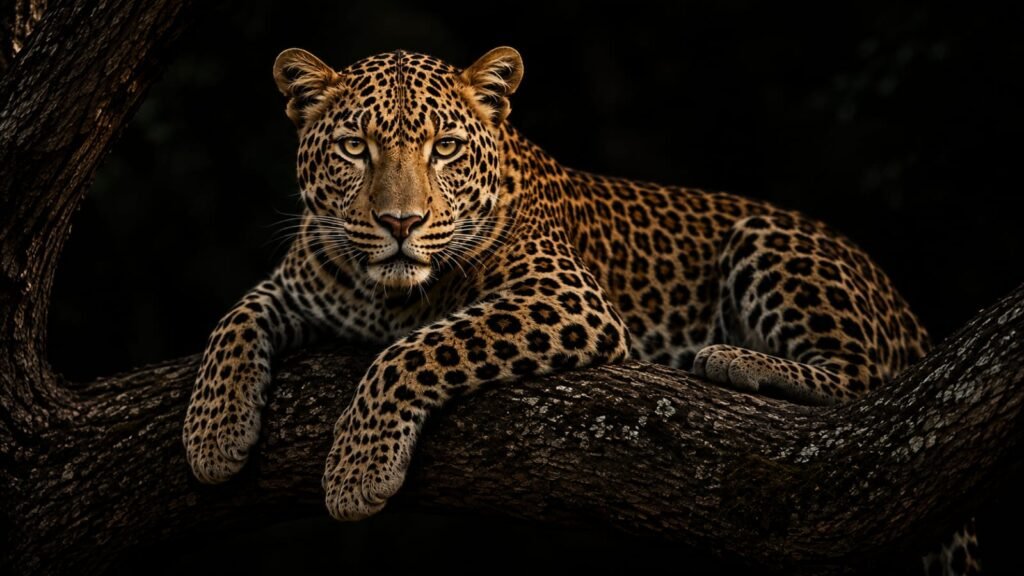
Here in lies a major question:
Why do leopards move into human-dominated landscapes when they can also survive in natural forests? And why do some of them come into conflict with people?
At first glance, this may seem like a straightforward case of human–leopard conflict.
But it would be too simple to see it only as a case of a leopard leaving the forest and entering human territory. In many places, forests, farmland and villages have become part of the same connected landscape.
To understand this conflict, we need to look at the leopard’s nature, its needs, its natural habitat and the changes that human activity has brought to that habitat.
Who Is the Leopard?
The leopard (Panthera pardus) is a large cat species in the Panthera genus.
The same genus also includes the tiger, lion and jaguar. The leopard is known for its powerful body, agility, stealthy hunting skills and remarkable ability to adapt to changing environments.
How Is the Leopard Different from Other Big Cats?
The big cat family includes several remarkable predators, including the leopard. But each species has its own nature, behaviour and habitat preferences.
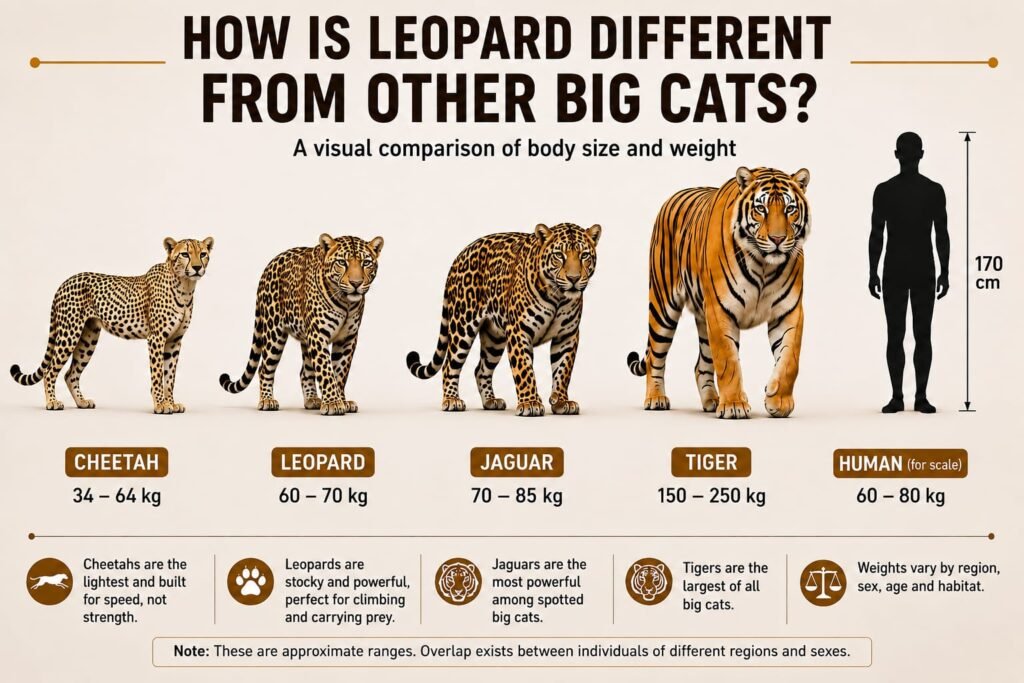
Tiger: The tiger is a much larger predator and generally depends on larger prey. It needs an adequate prey base and a relatively large territory. It is mainly a ground-dwelling animal.
Lion: The lion differs from the tiger and leopard in one major way. It is generally a social cat. Lions live in prides, while tigers and leopards are mainly solitary. Open grasslands and savannas are among their major habitats.
Cheetah: The cheetah is not a member of the Panthera genus. Its scientific name is Acinonyx jubatus. Its greatest strength is speed. It catches small and medium-sized prey by chasing them across open ground.
Jaguar: The jaguar belongs to the Panthera genus and is a close relative of the leopard. It is found mainly in Central and South America. Like the leopard, it is an excellent climber. It is also known for its affinity for water and its ability to swim.
Leopard: Among these big cats, the leopard stands out for its extraordinary adaptability. It can survive in forests, scrublands, mountains and agricultural landscapes. In many places, it can even live close to human settlements.
The Nature of the Leopard
Because of its unique qualities, the leopard holds a special place among the big cats.
According to Jim Corbett, it is:
“The most beautiful and graceful of all the animals in our jungles.”
Beauty, agility, courage and remarkable hunting ability come together in this one animal. These qualities make the leopard one of nature’s most fascinating predators.
Let us look at the leopard’s distinctive traits.
Solitary Animal: Prefers to live alone
The leopard is generally a solitary animal. Adult males and females usually live separately and meet mainly for breeding. A female stays with her cubs for some time.
Territorial: Marks and defends its territory
Each leopard establishes a territory of its own. It uses scent marks, scratch marks and other signs to communicate its presence and warn other leopards to keep away.
Highly Adaptable: Adapts to changing environments
The leopard can adapt to a wide range of conditions. It can survive in dense forests, scrublands, mountainous areas and agricultural landscapes, as long as suitable resources are available.
Excellent Climber: An expert at climbing trees
The leopard is one of the most skilled climbers among the big cats. Its strong limbs, powerful claws and muscular body help it climb trees with ease. It can even carry its prey up a tree.
Generally Elusive: Prefers to keep its distance from humans
The leopard generally avoids humans and is difficult to spot. It moves quietly and cautiously. When it senses danger, it usually prefers to hide or move away rather than confront people.
Uses Cover: Hiding is part of its hunting strategy
The leopard uses dense vegetation both to hunt and to stay safe. Bushes, tall grass, sugarcane fields and thick forest vegetation provide excellent cover and help it remain hidden.
Opportunistic Predator: Can take advantage of available prey
The leopard does not depend on a single type of prey. It can hunt different animals depending on its habitat and the opportunities available. This flexible and opportunistic behaviour is one of its greatest survival strengths.
Adapts Its Activity to Human Activity
The leopard can change its behaviour in areas with high human activity. It may become more active at night when fewer people are around. This helps reduce the chances of encountering humans.
The Leopard Is Not Only a Forest Animal: It Can Survive Outside Forests
The leopard is certainly a forest animal, but it is not only a forest animal.
Its habitat is not limited to forest boundaries. Its extraordinary adaptability allows it to survive in farmlands, scrublands and even around human settlements.
The leopard does not depend only on large, continuous forests for survival. Its relatively small size and ability to hunt a variety of prey allow it to live comfortably even in small and fragmented habitats.
When suitable food, water and cover are available, many leopards can survive outside protected forests and even establish shelter close to human settlements. Farms, scrublands and dense crops such as sugarcane can provide both food and cover.
This is reflected in the findings of the Wildlife Institute of India (WII). In the Shivalik landscape, nearly 65% of leopards were found to live outside protected areas.
This remarkable ability to survive beyond forests is one of the leopard’s greatest strengths.
However, when its habitat overlaps closely with human settlements, the chances of human–leopard conflict also increase.
There Is No Clear Boundary Between the Forest and the Village for Leopards
We often think of the forest as an area within a fixed boundary and the village as the area outside it. This boundary may be clear on a map, but it is not always clear to wildlife.
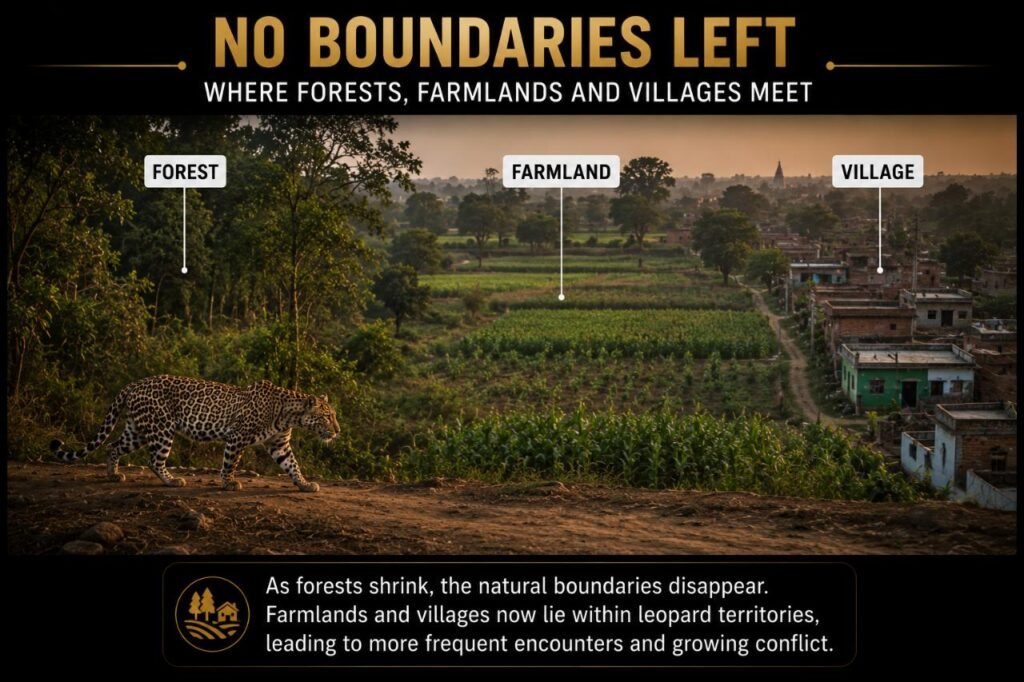
A forest does not always end where a village begins. Between forests and villages, there may be scrubland, grasslands, streams, farmland, sugarcane fields and small patches of forest. Together, they form a connected landscape.
Most wildlife does not recognize the boundaries drawn by humans between forests and villages.
When necessary, animals can move from forests into farmland and villages. But every predator uses this human-dominated landscape in a different way.
Large predators such as lions and tigers generally depend on relatively large prey because of their body size and food requirements. Their natural needs keep them mainly in habitats where they can find enough wild prey, cover and safe space.
Under normal conditions, they tend to stay in their natural habitats rather than around human settlements.
But the leopard is different.
Its smaller size, ability to hunt prey of different sizes and extraordinary adaptability allow it to use farmland, scrubland and areas around human settlements connected to forests.
The leopard can use this entire landscape. It may hide in dense bushes or fields during the day, move through farmland at night and return to the forest.

For a leopard, this area between the forest and the village is not just a route. In many cases, it can also provide food, cover and shelter.
For a tiger or lion, the forest is generally their primary habitat. A leopard, however, can make the landscape beyond the forest part of its habitat as well.
Therefore, seeing a leopard near a village does not always mean that it has left the forest.
The problem begins when humans and leopards come too close to each other in this shared landscape.
People working in fields and livestock moving freely around villages can bring leopards closer to human settlements. Dense crops can also provide them with ideal cover.
This is why we cannot understand human–leopard conflict simply by asking whether the leopard is inside or outside the forest.
We need to look at how forests, farmland and villages are connected, and how both humans and wildlife use this shared landscape.
We should remember one thing:
Our maps may show a boundary between the forest and the village, but that boundary means little to a leopard.
Stealth Hunter: The Leopard Is an Expert at Silent Attacks
The leopard is a highly skilled and stealthy hunter. It uses cover to get close to its prey and can attack with great speed. Sometimes, the attack is so sudden and quiet that even people nearby may not notice it immediately.
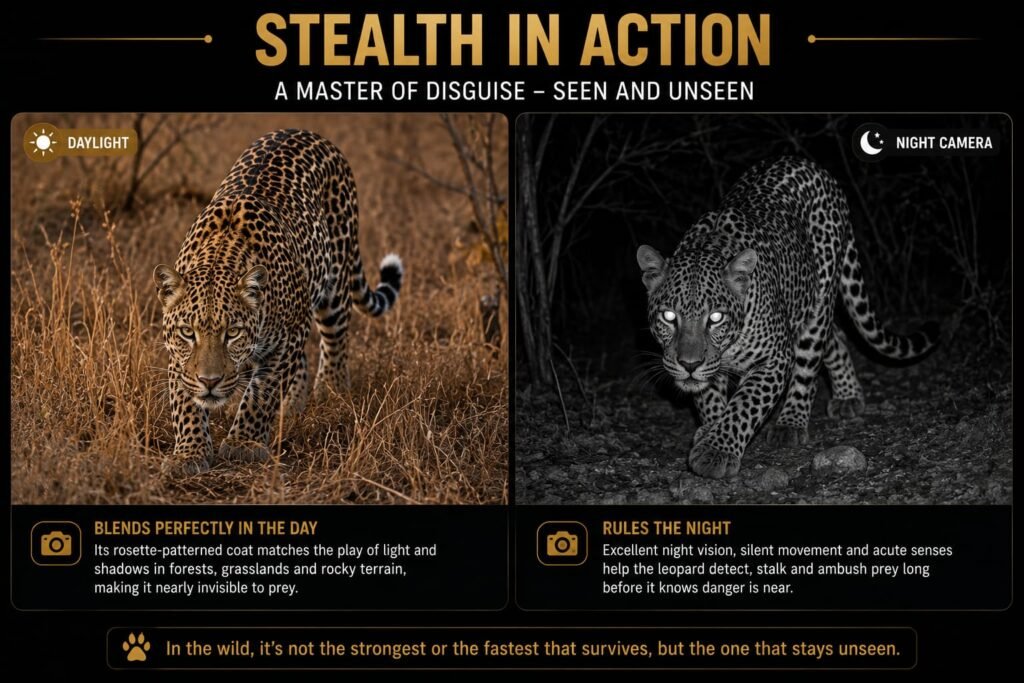
A leopard may use its powerful jaws to hold the neck or throat area of its prey and quickly immobilize it.
This can make the prey helpless within a very short time. However, not every leopard attack follows exactly the same method.
In this context, two incidents described by the famous hunter and naturalist Jim Corbett in his book The Man-Eating Leopard of Rudraprayag are particularly relevant.
Incident 1
Corbett described an incident in which a large group of pilgrims was sleeping at a shelter at night. A hill woman was also sleeping among them.
During the night, the leopard quietly carried the woman away. When the people woke up in the morning, they found that the woman was missing. Those sleeping around her had not realized what had happened.
The incident shows the leopard’s extraordinary ability to move and attack with stealth.
Incident 2
In another incident, a woman was climbing the steps to her house. She was carrying a pot filled with water on her head. Her young son was walking behind her, also carrying a pot of water on his head.
Suddenly, the woman heard the sound of a pot falling behind her. She turned around and saw the pot lying on the steps, but her son was not there.
The leopard had suddenly attacked the boy and carried him away. His body was found later.
This incident shows how quickly and quietly a leopard can attack its prey. People may not always get a warning or hear a struggle before an attack.
What Does the Thakurdwara Incident Tell Us?
A worrying pattern has also emerged in the recent leopard attacks in the Thakurdwara area. According to newspaper reports, all three women who died had injuries to the neck caused by the leopard’s attack.
Mithilesh Devi was attacked while several other people, including her husband, were present in the field. Even then, the leopard suddenly attacked her.
The deaths of three women have highlighted the seriousness of the Human–Leopard Conflict in this region.
Leopard attacks remain a matter of concern even when people take precautions and work together in groups.
However, it would not be appropriate to reduce this problem to simply calling leopards “man-eaters” or capturing them in cages.
We need to look deeper into why leopards are coming so close to human settlements and agricultural fields.
We also need to understand whether their behaviour is changing.
We also need to understand how the changing landscape of forests, farms and villages is bringing humans and leopards closer to each other.
Only by understanding these factors can we find a lasting solution to this conflict.
Why Do Leopards Move from Forests Towards Human Settlements?
Leopards are often seen around human settlements. However, lack of food in the forest is not the only reason they move closer to people. It is only one possible factor.
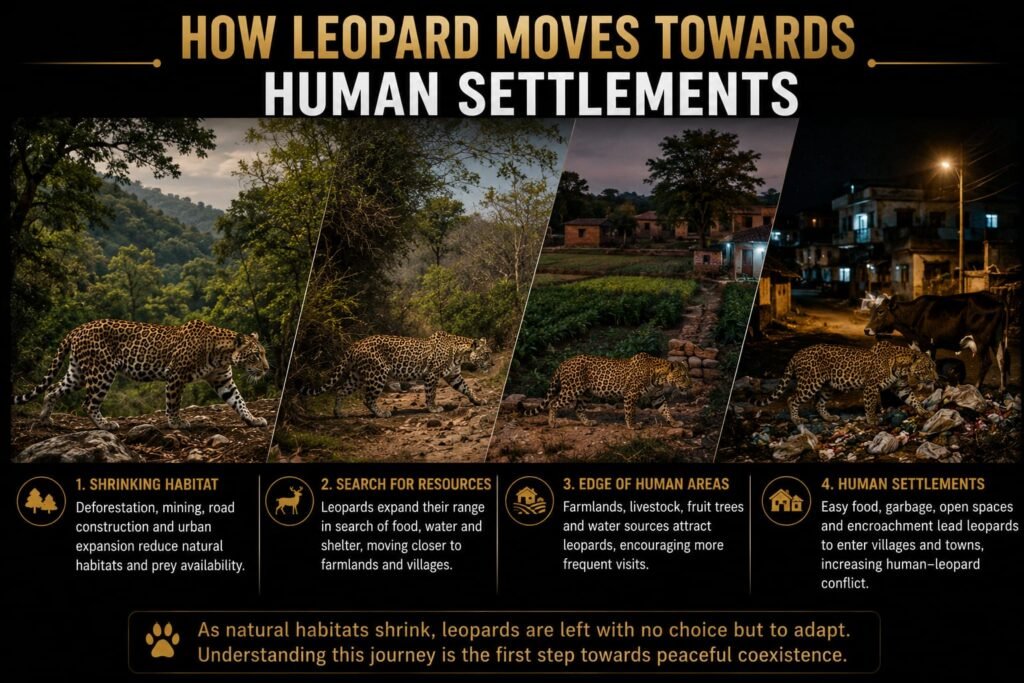
In many landscapes, leopards have been found using human-dominated areas even when enough wild prey is available in the surrounding forests.
If we look at the Thakurdwara region, the areas where leopard attacks have occurred lie close to the forests of Amangarh. These forests also support a good population of wild prey.
A study published in 2024, involving researchers from the Wildlife Institute of India, estimated the density of five major prey species in Amangarh Tiger Reserve.
The estimates were based on field surveys conducted in 2021.
The total estimated prey density was 62.7 ± 11 animals per square kilometre.
The estimated densities of the major prey species were:
- Chital – about 23 animals/km²
- Sambar – about 14 animals/km²
- Wild boar – about 13 animals/km²
- Nilgai – about 11 animals/km²
- Barking deer – recorded, but its individual density was not estimated.
Source: Journal of Wildlife Science (JWLS)
Overall the estimated density of these five prey species was about 63 animals per square kilometre.
The researchers considered this prey density a viable prey base for large carnivores.
This suggests that a lack of natural prey alone cannot explain why leopards use areas close to villages.
So, why do leopards move towards human settlements?
One important reason is the leopard’s remarkable adaptability. Around villages, it may find food, water and cover relatively easily.
Let us look at the main reasons.
1. Easy Availability of Food
Around villages, leopards may find relatively easy prey such as goats, dogs, pigs, calves and other domestic animals. They may not always need to make the effort required to hunt wild prey in the forest.
2. Dense Crops, especially Sugarcane
Tall crops can provide cover similar to that found in a forest. A leopard can hide in a sugarcane field during the day and move out quietly at night.
For a leopard, farmland is therefore not just agricultural land. Under suitable conditions, it can also function as a temporary habitat.
3. A Continuous Landscape Between Forest and Village
In many places, the forest does not suddenly end and a village begin. Between them, there may be scrubland, streams, riverside vegetation, farmland and small forest patches.
The leopard can use this entire forest–farm–village landscape.
4. Availability of Water
Water is often available around villages, farms, ponds and canals. During periods of heat or drought, these water sources can influence the movement of wildlife.
5. Extraordinary Adaptability
This is one of the most important factors.
Tigers generally need relatively large and secure forest landscapes. Leopards, however, can survive in smaller and fragmented habitats.
Even a small patch of suitable habitat close to a village can provide enough cover and resources for a leopard to survive.
6. Expert at Outsmarting Humans
The leopard is remarkably skilled at staying one step ahead of humans.
It can respond human activity and change its own behaviour accordingly.
Where people are active during the day, a leopard may become more active at night.
It can use bushes, tall crops and other cover to move around without being noticed.
This ability allows the leopard to live close to human settlements while remaining hidden for long periods.
How Can We Reduce Human–Leopard Conflict?
Human–leopard conflict cannot be solved simply by capturing leopards and releasing them elsewhere.
The leopard is highly adaptable.
It can live not only in forests but also around farms, scrublands and villages.
Therefore, the long-term goal should not be to eliminate leopards or keep them away from every human settlement. Our aim should be to reduce dangerous encounters between humans and leopards.
The following measures can help reduce this conflict.
1. Do Not Make Villages Attractive to Leopards
Where food is easily available, leopards may be more likely to come closer to villages.
Goats, calves and other domestic animals should not be left in the open around villages.
Livestock should be kept in strong and secure enclosures at night. Animal carcasses and meat waste should also not be left in the open.
2. Take Extra Care in Sugarcane and Other Dense Crops
Tall crops can provide good cover for a leopard. A sugarcane field can offer a place to hide during the day and move out quietly at night.
People should therefore be especially careful while working in such fields.
In areas where a leopard has been reported, people should avoid going into fields alone. Working in groups can reduce risk, but it does not guarantee safety.
People should also follow the warnings and instructions of the Forest Department.
In dense crops, a leopard can remain hidden until a person comes very close. Therefore, early warning and vigilance are more important than simply increasing the number of people in a group.
3. Do Not Surround a Leopard
If a leopard is seen, people should not gather around it, chase it, throw stones at it or try to trap it in a circle.
A frightened leopard may attack if it feels threatened or cannot find a way to escape.
The right response is simple:
- Keep away from the leopard.
- Move other people away from the area.
- Do not chase or surround it.
- Inform the Forest Department immediately.
4. Monitor Leopard Activity Around Villages
If a leopard is repeatedly seen in an area, we should not simply wait for the next sighting.
Camera traps and local sightings can help identify where the leopard is coming from, which routes it uses and when it is most active.
This can help identify conflict hotspots and allow authorities to focus surveillance and safety measures in those areas.
5. Fencing Can Be Used at Sensitive Locations
In places where leopards repeatedly enter villages or farms, suitable fencing can be considered as a preventive measure.
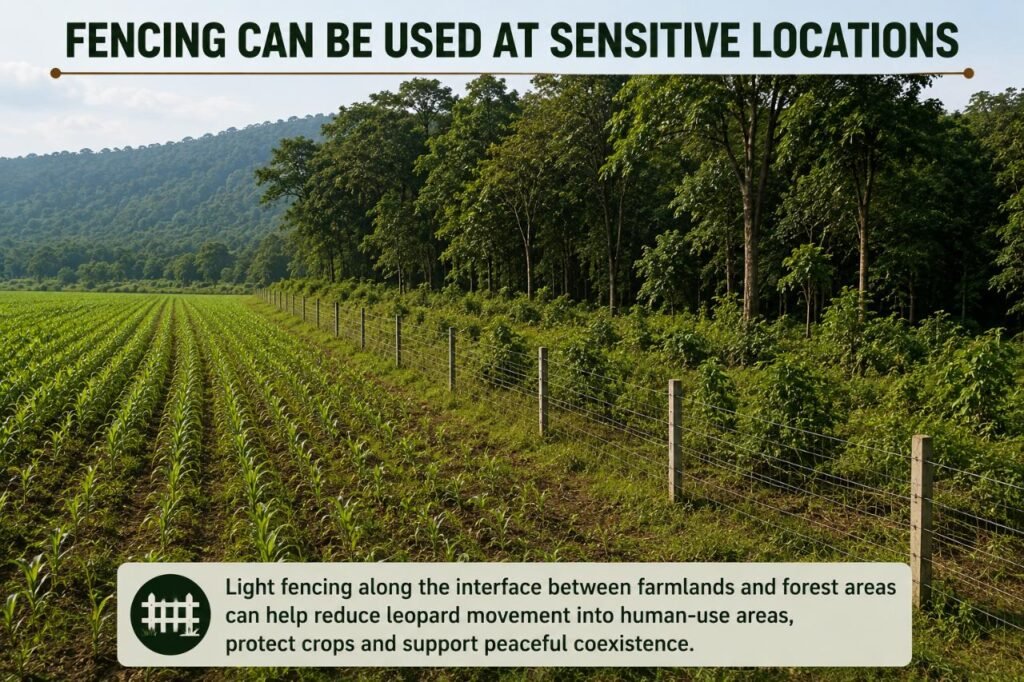
Fencing may be useful around village boundaries, livestock enclosures and other identified conflict-prone locations.
However, entire forests should not be fenced off.
Large-scale fencing can obstruct the natural movement of leopards, tigers, elephants and other wildlife. It can also disrupt important wildlife corridors.
Therefore, fencing should be used selectively at specific and sensitive locations rather than across entire forest landscapes.
6. Do Not Consider Every Leopard a “Man-Eater”
This is one of the most important points.
A leopard seen near a village should not automatically be considered a man-eater. A leopard may enter a human-dominated area without having any intention of attacking people.
If a particular leopard repeatedly attacks humans, the Forest Department should assess that individual animal and the circumstances before deciding on an appropriate management response.
7. Capturing and Relocating a Leopard Is Not a Routine Solution
Capturing a problem leopard and releasing it somewhere else may appear to be an easy solution. But the new area may already be the territory of another leopard.
Relocation can also create problems for the relocated animal and may simply move the conflict to another place.
Therefore, translocation should not be treated as a routine solution. It should be considered only after assessing the individual animal, the location and the circumstances.
8. Keeping Forests Healthy Is Also Part of Conflict Reduction
Healthy habitats and adequate natural prey are important for wildlife. But increasing prey in a forest does not necessarily mean that leopards will stop entering villages.
Because of their adaptability, leopards can use both wild prey and food resources available around farms and villages.
Therefore, habitat conservation must go hand in hand with livestock protection and changes in human behaviour.
9. The Most Important Measure – Understand Leopard Behaviour
Local people have an important role to play in reducing human–leopard conflict.
People should know how leopards normally behave, when the risk of an encounter may increase and what they should do if they see one.
People should stay alert and watch for signs of a leopard nearby.
If they notice its presence, they should keep away from it.
They should never try to surround, chase, attack or provoke it. These simple precautions can greatly reduce the risk of conflict.
By taking these measures and staying alert, we can greatly reduce the risk of human-leopard conflict and avoid many dangerous encounters.
Conclusion:
The leopard is a remarkable survivor, highly adaptable and skilled at living in changing landscapes. But when forests, farms and villages overlap, this adaptability can bring leopards and humans dangerously close. Understanding the leopard and managing this shared landscape wisely is the key to reducing human–leopard conflict.
